Last month, 73.4 percent of Las Vegas-area homes and condos that were resold had been previously foreclosed on in the prior 12 months, according to DataQuick.
That’s up from the 55.9 percent share that was distressed a year earlier, a sign that the crisis is far from over.
The only good news (if you want to call it that), is that sales are up, with 4,536 new and resale homes and condos closing escrow during the month, up 1.9 percent from April and 23 percent from a year ago.
To view original article click here
Other good articles...
JPMorgan Tightens Grip on Equity Sales by Selling Own Shares
...helped by the sale of shares of financial firms, including their own.
Paper Avalanche Buries Plan to Stem Foreclosures
Think of the documents as being part of a pile massing inside the bank
Recovery threatened by toxic assets still hidden in key banks
Governments too slow to act, warn
Toxic Assets (PPIP) Death Rattle
Remember, folks, that the DOW surged by more than 500 points, a 7% gain, on the day the PPIP was announced.
Monday, June 29, 2009

Friday, June 26, 2009
JPMorgan, Citigroup Expand in ‘Jumbo’ Loans for Expensive Homes
June 26 (Bloomberg) -- JPMorgan Chase & Co. and Citigroup Inc. are expanding in “jumbo” mortgages used to buy the most expensive homes, helping revive a market that shriveled amid a three-year jump in homeowner defaults.
JPMorgan resumed buying new jumbo loans made by other lenders this month, after halting purchases in March, spokesman Tom Kelly said. Borrowers must have checking accounts with the bank, he said. Citigroup is again offering the loans through independent mortgage brokers, spokesman Mark Rodgers said.
The two New York-based banks are signaling new interest in a market hobbled since 2007, when record-breaking defaults on home loans caused investors to flee securities backed by mortgages. With the recession sapping demand for new consumer and corporate loans, lenders are competing harder for creditworthy customers, said Harry Davis, banking professor at Appalachian State University in Boone, North Carolina.
“They have surely across the board raised lending standards, and there aren’t a lot of good borrowers standing in the lobby,” Davis said in an interview.
To read the original article click here
Other interesting articles...
Loan Modifications Up at Fannie, Freddie, But So Are Late Payments
Loan modifications at Fannie Mae and Freddie Mac were up 57 percent in the first quarter
41 Charges as Mortgage Fraud Hits Condos & Suburbs
Federal law enforcement officials recently announced charges have brought against 41 defendants in five separate cases in Chicago.
REQUIRED READING: The Fannie And Freddie Quandary
It's a perfect time to think about the fundamental restructuring of the world famous (and now broke) government-sponsored enterprises (GSEs) Fannie Mae and Freddie Mac.
Rep. Issa Says Fed ‘Engaged in a Cover-Up’ on Merrill-Bofa
U.S. Congressman Darrell Issa said the Federal Reserve “engaged in a cover-up”
JPMorgan resumed buying new jumbo loans made by other lenders this month, after halting purchases in March, spokesman Tom Kelly said. Borrowers must have checking accounts with the bank, he said. Citigroup is again offering the loans through independent mortgage brokers, spokesman Mark Rodgers said.
The two New York-based banks are signaling new interest in a market hobbled since 2007, when record-breaking defaults on home loans caused investors to flee securities backed by mortgages. With the recession sapping demand for new consumer and corporate loans, lenders are competing harder for creditworthy customers, said Harry Davis, banking professor at Appalachian State University in Boone, North Carolina.
“They have surely across the board raised lending standards, and there aren’t a lot of good borrowers standing in the lobby,” Davis said in an interview.
To read the original article click here
Other interesting articles...
Loan Modifications Up at Fannie, Freddie, But So Are Late Payments
Loan modifications at Fannie Mae and Freddie Mac were up 57 percent in the first quarter
41 Charges as Mortgage Fraud Hits Condos & Suburbs
Federal law enforcement officials recently announced charges have brought against 41 defendants in five separate cases in Chicago.
REQUIRED READING: The Fannie And Freddie Quandary
It's a perfect time to think about the fundamental restructuring of the world famous (and now broke) government-sponsored enterprises (GSEs) Fannie Mae and Freddie Mac.
Rep. Issa Says Fed ‘Engaged in a Cover-Up’ on Merrill-Bofa
U.S. Congressman Darrell Issa said the Federal Reserve “engaged in a cover-up”
Wednesday, June 24, 2009
Not Paying the Mortgage, Yet Stuck With the Keys
Foreclosure Backlog Imperils Recovery
A growing number of American homeowners are falling into financial limbo: They're badly behind on payments, but their banks have not yet foreclosed.
The backlog of seriously delinquent mortgages, which so far affects about 1 million borrowers, is a shadow over hopes for a rebound in the nation's housing markets. It masks the full extent of the foreclosure crisis and threatens to depress prices even further just as some parts of the country are hinting at recovery. For lenders, it could portend even more financial losses tied to the mortgage meltdown.
"It just means foreclosure rates are going to keep rising," said Patrick Newport, an economist for IHS Global Insight.
Rising mortgage delinquencies were at the root of the recession, and many economists say an economic recovery will be difficult until the housing market recovers and home prices stabilize.
And even though a delayed foreclosure can be a blessing for some troubled homeowners, for others, it simply prolongs the financial distress, leaving them on the hook for the condition of the property. Even if they move out, they cannot move on.
To read the entire article click here
Other interesting articles...
Citigroup Halts Some Mortgage Applications, Cites Missing
DataCitigroup Inc. suspended loan applications at a unit that produced half of its $115 billion in mortgages last year
Banks Oppose Financial Agency; Consumers Seek Clarity
U.S. bankers lined up against a new federal oversight agency proposed by President Barack Obama,
A growing number of American homeowners are falling into financial limbo: They're badly behind on payments, but their banks have not yet foreclosed.
The backlog of seriously delinquent mortgages, which so far affects about 1 million borrowers, is a shadow over hopes for a rebound in the nation's housing markets. It masks the full extent of the foreclosure crisis and threatens to depress prices even further just as some parts of the country are hinting at recovery. For lenders, it could portend even more financial losses tied to the mortgage meltdown.
"It just means foreclosure rates are going to keep rising," said Patrick Newport, an economist for IHS Global Insight.
Rising mortgage delinquencies were at the root of the recession, and many economists say an economic recovery will be difficult until the housing market recovers and home prices stabilize.
And even though a delayed foreclosure can be a blessing for some troubled homeowners, for others, it simply prolongs the financial distress, leaving them on the hook for the condition of the property. Even if they move out, they cannot move on.
To read the entire article click here
Other interesting articles...
Citigroup Halts Some Mortgage Applications, Cites Missing
DataCitigroup Inc. suspended loan applications at a unit that produced half of its $115 billion in mortgages last year
Banks Oppose Financial Agency; Consumers Seek Clarity
U.S. bankers lined up against a new federal oversight agency proposed by President Barack Obama,
Tuesday, June 23, 2009
May existing home sales rose 2.4 percent
Existing home sales rose 2.4 percent in May; prices plunge 16.8 percent
By Alan Zibel, AP Real Estate Writer
On Tuesday June 23, 2009, 10:40 am EDT
WASHINGTON (AP) -- Sales of previously occupied homes rose modestly from April to May, the third monthly increase this year, but signs of a housing recovery are fragile at best. The National Association of Realtors said Tuesday that home sales rose 2.4 percent last month to a seasonally adjusted annual rate of 4.77 million, from a downwardly revised pace of 4.66 million in April.
About one out of every three homes sold was a foreclosure or distressed sale. That helped drag down the median price to $173,000 -- 16.8 percent below a year ago.
Falling prices coupled with new rules for property appraisers have caused many transactions to fall apart or be delayed.
"We have just been flooded with e-mails, telephone calls on the appraisal problems," said Lawrence Yun, the Realtors' chief economist.
To read the original article click here
You may also want to read...
S&P Downgrades More U.S. Prime Jumbo RMBS
Economic Crisis Stirs Free-Market Debate
U.S. Economy: Slide in Home Prices Spurs Increase in Resales
By Alan Zibel, AP Real Estate Writer
On Tuesday June 23, 2009, 10:40 am EDT
WASHINGTON (AP) -- Sales of previously occupied homes rose modestly from April to May, the third monthly increase this year, but signs of a housing recovery are fragile at best. The National Association of Realtors said Tuesday that home sales rose 2.4 percent last month to a seasonally adjusted annual rate of 4.77 million, from a downwardly revised pace of 4.66 million in April.
About one out of every three homes sold was a foreclosure or distressed sale. That helped drag down the median price to $173,000 -- 16.8 percent below a year ago.
Falling prices coupled with new rules for property appraisers have caused many transactions to fall apart or be delayed.
"We have just been flooded with e-mails, telephone calls on the appraisal problems," said Lawrence Yun, the Realtors' chief economist.
To read the original article click here
You may also want to read...
S&P Downgrades More U.S. Prime Jumbo RMBS
Economic Crisis Stirs Free-Market Debate
U.S. Economy: Slide in Home Prices Spurs Increase in Resales
Monday, June 22, 2009
Fed plans repo markets revamp
By Henny Sender and Michael Mackenzie in New York
Published: June 21 2009 22:31 Last updated: June 21 2009 22:31
The US Federal Reserve is considering dramatic changes to the giant repurchase – or repo – markets where banks around the world raise overnight dollar loans.
The plans include creating a utility to replace the Wall Street banks that handle transactions, people familiar with the matter say.
The Fed’s deliberations are partly motivated by concerns that the structure of the US overnight repurchase market may have exacerbated the financial turmoil that accompanied the failure of Lehman Brothers in September last year.
Fed officials plan to meet next month with market participants to discuss reforms.
People familiar with the Fed’s thinking say it is looking into the creation of a mechanism to replace the clearing banks – the biggest of which are JPMorgan Chase and Bank of New York Mellon – that serve as intermediaries between borrowers and lenders.
“The Fed is raising questions about whether the system really protects the interests of all participants,” says one person familiar with the Fed’s thinking.
In the repo markets, borrowers, such as banks, pledge collateral in return for overnight loans from lenders, such as money market funds.
To read the original article click here
You may also want to read...
Making Home Affordable program may help more underwater homeowners
The Making Home Affordable program may be further expanded to help more underwater homeowners refinance their mortgages.
FHA warns it may need assistance top operate
The FHA continues to be overwhelmed by surging loan volume, as evidenced by remarks from Kenneth M. Donohue, Inspector General of HUD.
No recovery for U.S. property markets until 2017
The U.S. urban commercial real estate markets probably will not recover until 2017
Fed meeting gets underway
The Federal Open Market Committee begins a two-day meeting on interest rate policy.
Published: June 21 2009 22:31 Last updated: June 21 2009 22:31
The US Federal Reserve is considering dramatic changes to the giant repurchase – or repo – markets where banks around the world raise overnight dollar loans.
The plans include creating a utility to replace the Wall Street banks that handle transactions, people familiar with the matter say.
The Fed’s deliberations are partly motivated by concerns that the structure of the US overnight repurchase market may have exacerbated the financial turmoil that accompanied the failure of Lehman Brothers in September last year.
Fed officials plan to meet next month with market participants to discuss reforms.
People familiar with the Fed’s thinking say it is looking into the creation of a mechanism to replace the clearing banks – the biggest of which are JPMorgan Chase and Bank of New York Mellon – that serve as intermediaries between borrowers and lenders.
“The Fed is raising questions about whether the system really protects the interests of all participants,” says one person familiar with the Fed’s thinking.
In the repo markets, borrowers, such as banks, pledge collateral in return for overnight loans from lenders, such as money market funds.
To read the original article click here
You may also want to read...
Making Home Affordable program may help more underwater homeowners
The Making Home Affordable program may be further expanded to help more underwater homeowners refinance their mortgages.
FHA warns it may need assistance top operate
The FHA continues to be overwhelmed by surging loan volume, as evidenced by remarks from Kenneth M. Donohue, Inspector General of HUD.
No recovery for U.S. property markets until 2017
The U.S. urban commercial real estate markets probably will not recover until 2017
Fed meeting gets underway
The Federal Open Market Committee begins a two-day meeting on interest rate policy.
Friday, June 19, 2009
Rates Fall Back on Lower Inflation
By DIANA GOLOBAY June 18, 2009 10:39 AM CST
Average mortgage rates across the board fell in the week ending June 18 after spiking briefly the week before, according to a survey released today by mortgage giant Freddie Mac (FRE: 0.7353 +2.12%).
“Reports of benign inflation figures reversed the upward trend of mortgage rates this week,” however, “it’s still too early to tell whether the decline in housing market activity has hit bottom yet,” says Frank Nothaft, Freddie’s chief economist, in a media statement today.
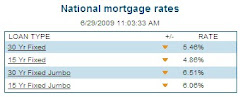
Thirty-year fixed mortgages (FRMs) averaged 5.38% rates with an average 0.7 point, down from 5.59% last week. The average rate for a 15-year FRM came in at 4.89% with an average 0.7 point, from 5.06% last week. Five-year adjustable-rate mortgages (ARMs) averaged 4.97% with an average 0.6 point, from 5.17% last week, while one-year ARMs averaged 4.95% with an average 0.6 point, from 5.19% the week before.
A separate survey conducted by Bankrate.com confirmed a drop in rates, with 30-year FRMs averaging 5.76% with an average 0.43 point, down from 5.96% the previous week. Bankrate’s data also found 15-year FRMs down to 5.19% from 5.37%.
“The concerns about eventual inflation that drove bond yields and mortgage rates higher have been tempered by the reality of continued weakness in the economy,” Bankrate said in a media statement.
To read the original article click here
Additional articles of interest...
Originate to Distribute Mortgages Default More
Mortgages sold on the secondary market quickly after being originated were underwritten more poorly than loans kept on bank’s books, according to a report from the University of Michigan Ross School of Business.
We’ve Gone From Saving Wall Street in Order to Save Main Street to Just Saving Wall Street
But parsing through his 85-page plan, it's not clear how these reforms will ensure that our financial system works for the economy as a whole.
Wall Street isn’t buying Obama’s reform plan
Banks and other firms are quick to attack Obama's consumer-friendly overhaul of financial rules. The stage is set for a legislative battle, with Wall Street turning to allies in Congress.
Average mortgage rates across the board fell in the week ending June 18 after spiking briefly the week before, according to a survey released today by mortgage giant Freddie Mac (FRE: 0.7353 +2.12%).
“Reports of benign inflation figures reversed the upward trend of mortgage rates this week,” however, “it’s still too early to tell whether the decline in housing market activity has hit bottom yet,” says Frank Nothaft, Freddie’s chief economist, in a media statement today.
Thirty-year fixed mortgages (FRMs) averaged 5.38% rates with an average 0.7 point, down from 5.59% last week. The average rate for a 15-year FRM came in at 4.89% with an average 0.7 point, from 5.06% last week. Five-year adjustable-rate mortgages (ARMs) averaged 4.97% with an average 0.6 point, from 5.17% last week, while one-year ARMs averaged 4.95% with an average 0.6 point, from 5.19% the week before.
A separate survey conducted by Bankrate.com confirmed a drop in rates, with 30-year FRMs averaging 5.76% with an average 0.43 point, down from 5.96% the previous week. Bankrate’s data also found 15-year FRMs down to 5.19% from 5.37%.
“The concerns about eventual inflation that drove bond yields and mortgage rates higher have been tempered by the reality of continued weakness in the economy,” Bankrate said in a media statement.
To read the original article click here
Additional articles of interest...
Originate to Distribute Mortgages Default More
Mortgages sold on the secondary market quickly after being originated were underwritten more poorly than loans kept on bank’s books, according to a report from the University of Michigan Ross School of Business.
We’ve Gone From Saving Wall Street in Order to Save Main Street to Just Saving Wall Street
But parsing through his 85-page plan, it's not clear how these reforms will ensure that our financial system works for the economy as a whole.
Wall Street isn’t buying Obama’s reform plan
Banks and other firms are quick to attack Obama's consumer-friendly overhaul of financial rules. The stage is set for a legislative battle, with Wall Street turning to allies in Congress.
Thursday, June 18, 2009
Too Big to Fail, or Succeed

Everyone will want to become big enough to enjoy 'systemic risk' protection. By Peter J. Wallison
In a speech at the White House yesterday, President Barack Obama outlined what he envisions for future regulation of the financial system. He called his plan "a new foundation for sustained economic growth . . . a transformation on a scale not seen since the reforms that followed the Great Depression." Indeed it is.
His plan, if adopted, will fundamentally change the nature of our financial system and economy. The underlying concerns and assumptions are clear, and they are made clearer by considering other ways that his administration has dealt with the consequences of competition -- particularly the faux bankruptcies of General Motors and Chrysler and the impending change in antitrust policy. Although the president said in his speech that he supports free markets, these initiatives confirm that the administration fears the "creative destruction" that free markets produce, preferring stability over innovation, competition and change.
To read original article click here
Other Articles of Interest...
The total number of people on the unemployment insurance rolls has dropped for the first time since early January, while first-time claims for benefits rose slightly, the Labor Department said Thursday.
Mortgage brokers will be obligated to sell the best available mortgage loans to avoid conflicts of interest between themselves and borrowers, while also determining the mortgages they sell are affordable to borrowers.
U.S. stocks snapped a three-day losing streak as reports on jobless claims and manufacturing added to evidence the recession may be near a bottom.
Wednesday, June 17, 2009
Bill Calls for $15,000 Any-Time Home Buyer Credit
The Mortgage Bankers Association (MBA) on Monday declared its support for a Senate bill, S 1230 or the Homebuyer Tax Credit Act of 2009, which expands the current first-time home buyer tax credit from $8,000 to $15,000.
The bill also makes the tax credit available to anyone who purchases a principal residence in the year following the enactment of the bill. The MBA is already calling for monetization of the credit at the closing table on the grounds that more consumers will become home buyers if they don’t have to struggle to put away a substantial down payment.
You many also find interesting...
Monday, June 15, 2009
IMF Chief: Worst of Global Crisis Not Yet Over
ASTANA--The worst of the global economic crisis is not yet over but there are signs that the world has started to crawl out of recession, International Monetary Fund chief Dominique Strauss-Kahn said on Monday.
Finance ministers of the Group of Eight nations agreed over the weekend that the global economy was showing encouraging signs of stabilisation and started to consider how to unwind rescue steps for their economies.
The IMF managing director said on a visit to Kazakhstan that he largely agreed with their position but he appealed for caution in assessing the state of the global economy.
"Their (G8) stance is that we are beginning to see some green shoots but nevertheless we have to be cautious ... The large part of the worst is not yet behind us," he said in opening remarks at talks with Kazakh Prime Minister Karim Masimov.
"We see, at the IMF, a recovery towards the beginning of 2010. 2009 is already done, we know it's a bad year," he added.
"At the global economic level, the growth will be -1.3 (percent) which is the first negative growth since the Depression.
2010 may be better and we expect recovery in the first half of 2010."
To read the original article click here
Other articles of interest...
Oil falls below $72 as US dollar strengthens
"Oil is still very strong given the weak overall fundamentals,"
Stay the Course
The debate over economic policy has taken a predictable yet ominous turn
Obama Financial Reforms Outlined in Op-ed Piece
Senior Obama administration officials Monday said in a newspaper op-ed piece that a landmark financial regulation reform plan to be released this week…
Finance ministers of the Group of Eight nations agreed over the weekend that the global economy was showing encouraging signs of stabilisation and started to consider how to unwind rescue steps for their economies.
The IMF managing director said on a visit to Kazakhstan that he largely agreed with their position but he appealed for caution in assessing the state of the global economy.
"Their (G8) stance is that we are beginning to see some green shoots but nevertheless we have to be cautious ... The large part of the worst is not yet behind us," he said in opening remarks at talks with Kazakh Prime Minister Karim Masimov.
"We see, at the IMF, a recovery towards the beginning of 2010. 2009 is already done, we know it's a bad year," he added.
"At the global economic level, the growth will be -1.3 (percent) which is the first negative growth since the Depression.
2010 may be better and we expect recovery in the first half of 2010."
To read the original article click here
Other articles of interest...
Oil falls below $72 as US dollar strengthens
"Oil is still very strong given the weak overall fundamentals,"
Stay the Course
The debate over economic policy has taken a predictable yet ominous turn
Obama Financial Reforms Outlined in Op-ed Piece
Senior Obama administration officials Monday said in a newspaper op-ed piece that a landmark financial regulation reform plan to be released this week…
Friday, June 12, 2009
Citigroup Bailout Pays Taxpayers Three Times as Much as S&P 500

June 12 (Bloomberg) -- U.S. taxpayers have reaped a 7.5 percent return on the $45 billion used to rescue Citigroup Inc., more than three times as much as if the money had been invested in the Standard & Poor’s 500 Index.
Chief Executive Officer Vikram Pandit, summoned by Congress in February to explain his bank’s use of the funds, vowed to “make this a profitable investment for the American people.” The return since the government first purchased a stake in the bank on Oct. 28, which includes dividends, compares with 2.4 percent for the S&P 500 on that basis.
To read the entire article click here
Topics of interest...
Chief Executive Officer Vikram Pandit, summoned by Congress in February to explain his bank’s use of the funds, vowed to “make this a profitable investment for the American people.” The return since the government first purchased a stake in the bank on Oct. 28, which includes dividends, compares with 2.4 percent for the S&P 500 on that basis.
To read the entire article click here
Topics of interest...
Obama himself has said little about specific proposals
Economists are worried at the sharp rise in home mortgage rates over the past couple of weeks.
U.S. consumers' mood strongest in 9 months
U.S. consumer confidence rose to a nine-month high in June…
U.S. consumer confidence rose to a nine-month high in June…
Feeling Poorer? U.S. Household Wealth Shrivels
American households lost $1.33 trillion of their wealth in the first three months of the year…
American households lost $1.33 trillion of their wealth in the first three months of the year…
Thursday, June 11, 2009
One million option arms to reset in next four years??
An estimated one million option arms are expected to reset higher over the next four years, according to a Bloomberg report.
About three quarters of these loans will adjust next year and in 2011, with resets peaking in August 2011 when 54,000 loans are set to lose their negative amortization feature.
More than $750 billion in option arms were originated between 2004 and 2008, with hard-hit California accounting for roughly 58 percent of them.
One borrower cited in the Bloomberg report received one of the most toxic option arms I’ve never heard of, with a start rate of just 0.375 percent and a negative amortization ceiling of 145 percent.
That particular borrower will experience massive payment shock, with the monthly mortgage payment rising to $3,500 from just $98.
Click here to read the entire article
About three quarters of these loans will adjust next year and in 2011, with resets peaking in August 2011 when 54,000 loans are set to lose their negative amortization feature.
More than $750 billion in option arms were originated between 2004 and 2008, with hard-hit California accounting for roughly 58 percent of them.
One borrower cited in the Bloomberg report received one of the most toxic option arms I’ve never heard of, with a start rate of just 0.375 percent and a negative amortization ceiling of 145 percent.
That particular borrower will experience massive payment shock, with the monthly mortgage payment rising to $3,500 from just $98.
Click here to read the entire article
FTC Testifies on Efforts to Combat Foreclosure Rescue and Loan Modification Scams
Is this as big of a problem as they would like for us to believe?? To identify only eleven in over a years time frame doesn’t seem to warrant an “intensified” effort to me. What do you think?
The Federal Trade Commission today told the U.S. House Subcommittee on Housing and Community Opportunity of the Committee on Financial Services that, with the rapid increase in mortgage delinquencies and foreclosures, the FTC has intensified its efforts to protect consumers from foreclosure rescue and loan modification scams. The FTC also recommended legislative and other remedies to enhance the agency’s effectiveness.
Read more here…
The Federal Trade Commission today told the U.S. House Subcommittee on Housing and Community Opportunity of the Committee on Financial Services that, with the rapid increase in mortgage delinquencies and foreclosures, the FTC has intensified its efforts to protect consumers from foreclosure rescue and loan modification scams. The FTC also recommended legislative and other remedies to enhance the agency’s effectiveness.
Read more here…
Wednesday, June 10, 2009
Stocks fall ahead of gov't report card on banks
Stocks slip ahead of decision on which banks can repay bailout funds; European markets drop
Stephen Bernard, AP Business Writer
On Monday June 8, 2009, 9:58 am EDT
NEW YORK (AP) -- Investors turned away from stocks ahead of the latest government report card on banks.
Stocks fell Monday, sending the Dow Jones industrial average down by about 100 points. Overseas markets also pulled back.
The government is expected to announce as early as Monday which banks will be allowed to return bailout funds. JPMorgan Chase & Co., Goldman Sachs Group Inc. and American Express Co. are expected to get approval to repay their loans, according to The Washington Post.
Other banks that were told by the government last month to raise funds to help protect against a potential worsening in the economy must submit plans Monday about how they are raising that capital.
Investors are also booking some gains from the market's three-month rally as concerns linger about the economy. The Standard & Poor's 500 index has surged 39 percent from a 12-year low on March 9. Interest rates on government bonds are higher and oil prices are near six-month highs.
To read the entire story click here
Stephen Bernard, AP Business Writer
On Monday June 8, 2009, 9:58 am EDT
NEW YORK (AP) -- Investors turned away from stocks ahead of the latest government report card on banks.
Stocks fell Monday, sending the Dow Jones industrial average down by about 100 points. Overseas markets also pulled back.
The government is expected to announce as early as Monday which banks will be allowed to return bailout funds. JPMorgan Chase & Co., Goldman Sachs Group Inc. and American Express Co. are expected to get approval to repay their loans, according to The Washington Post.
Other banks that were told by the government last month to raise funds to help protect against a potential worsening in the economy must submit plans Monday about how they are raising that capital.
Investors are also booking some gains from the market's three-month rally as concerns linger about the economy. The Standard & Poor's 500 index has surged 39 percent from a 12-year low on March 9. Interest rates on government bonds are higher and oil prices are near six-month highs.
To read the entire story click here
Monday, June 8, 2009
Supreme Court asked to block Chrysler sale to Fiat pending appeal
Mark Sherman, Associated Press Writer
On Sunday June 7, 2009, 9:56 am EDT
WASHINGTON (AP) -- Three Indiana state pension and construction funds want the Supreme Court to block Chrysler's sale to Fiat so they can pursue an appeal in hopes of getting a better deal.
The funds filed emergency papers at the high court early Sunday.
An appeals court in New York approved the sale Friday, but gave objectors until Monday afternoon to try to get the Supreme Court to intervene. Chrysler LLC wants to sell the bulk of its assets to a group led by Italy's Fiat Group SpA as part of its plan to emerge from bankruptcy protection.
To read the entire article click here
On Sunday June 7, 2009, 9:56 am EDT
WASHINGTON (AP) -- Three Indiana state pension and construction funds want the Supreme Court to block Chrysler's sale to Fiat so they can pursue an appeal in hopes of getting a better deal.
The funds filed emergency papers at the high court early Sunday.
An appeals court in New York approved the sale Friday, but gave objectors until Monday afternoon to try to get the Supreme Court to intervene. Chrysler LLC wants to sell the bulk of its assets to a group led by Italy's Fiat Group SpA as part of its plan to emerge from bankruptcy protection.
To read the entire article click here
Sunday, June 7, 2009
Fed damps hopes on mortgage-backed securities
By Aline van Duyn in New York
Published: June 4 2009 20:16 Last updated: June 4 2009 20:16
The US Federal Reserve on Thursday damped expectations that it was preparing to prop up the market for distressed bubble-era securities backed by mortgages.
Hopes that the Fed would in the coming months start providing financing to investors seeking to buy residential mortgage-backed securities (RMBS) – many of which have lost their triple A credit ratings – have pushed prices on these assets higher in recent months.
William Dudley, president of the Federal Reserve Bank of New York, said on Thursday that a decision had not been made. “We have not made a final decision on whether it is doable and, if it is doable, whether it is worth the cost,” he said.
Mr Dudley, who took over from Tim Geithner in January, has overseen the implementation of the $1,000bn term “asset-backed securities loan facility” (Talf), a key plank in the US government’s efforts to plug the hole left by the collapse of the asset-backed securities markets.
So far, the Talf has been used to finance the purchases of securities backed by loans to consumers, such as car and credit card loans. The Talf lends money to investors such as hedge funds on favorable terms, which encourages the purchases. This week, Talf financed 13 deals worth $16.4bn.
For the original article click here
Published: June 4 2009 20:16 Last updated: June 4 2009 20:16
The US Federal Reserve on Thursday damped expectations that it was preparing to prop up the market for distressed bubble-era securities backed by mortgages.
Hopes that the Fed would in the coming months start providing financing to investors seeking to buy residential mortgage-backed securities (RMBS) – many of which have lost their triple A credit ratings – have pushed prices on these assets higher in recent months.
William Dudley, president of the Federal Reserve Bank of New York, said on Thursday that a decision had not been made. “We have not made a final decision on whether it is doable and, if it is doable, whether it is worth the cost,” he said.
Mr Dudley, who took over from Tim Geithner in January, has overseen the implementation of the $1,000bn term “asset-backed securities loan facility” (Talf), a key plank in the US government’s efforts to plug the hole left by the collapse of the asset-backed securities markets.
So far, the Talf has been used to finance the purchases of securities backed by loans to consumers, such as car and credit card loans. The Talf lends money to investors such as hedge funds on favorable terms, which encourages the purchases. This week, Talf financed 13 deals worth $16.4bn.
For the original article click here
Saturday, June 6, 2009
FDIC Insurance Coverage
Extension of Temporary Increase in Standard Maximum Deposit Insurance Amount
President Obama has increased the insurance amount per depositor from $100,000 to $250,000. Can we afford that? Seems to me that the FDIC is taking quite a beating already. The increase is in effect until the end of 2013. Here’s the article:
Summary:
On May 20, 2009, President Barack Obama signed the Helping Families Save Their Homes Act, which extends the temporary increase in the standard maximum deposit insurance amount (SMDIA) to $250,000 per depositor through December 31, 2013. This extension of the temporary $250,000 coverage limit became effective immediately upon the President's signature. The legislation provides that the SMDIA will return to $100,000 on January 1, 2014.
Click here to read the entire article
President Obama has increased the insurance amount per depositor from $100,000 to $250,000. Can we afford that? Seems to me that the FDIC is taking quite a beating already. The increase is in effect until the end of 2013. Here’s the article:
Summary:
On May 20, 2009, President Barack Obama signed the Helping Families Save Their Homes Act, which extends the temporary increase in the standard maximum deposit insurance amount (SMDIA) to $250,000 per depositor through December 31, 2013. This extension of the temporary $250,000 coverage limit became effective immediately upon the President's signature. The legislation provides that the SMDIA will return to $100,000 on January 1, 2014.
Click here to read the entire article
Tuesday, June 2, 2009
Geithner tells China its dollar assets are safe
The students in China found our Timothy Geithner funny as he tries to convince them that their investment in our economy is safe...
Mon, 01 Jun 2009
From Reuters: Geithner tells China its dollar assets are safe “Chinese assets are very safe,” Geithner said in response to a question after a speech at Peking University, where he studied Chinese as a student in the 1980’s. His answer drew loud laughter from his student audience, reflecting skepticism in China about the wisdom of a developing….click here for the original story.
Mon, 01 Jun 2009
From Reuters: Geithner tells China its dollar assets are safe “Chinese assets are very safe,” Geithner said in response to a question after a speech at Peking University, where he studied Chinese as a student in the 1980’s. His answer drew loud laughter from his student audience, reflecting skepticism in China about the wisdom of a developing….click here for the original story.
Subscribe to:
Comments (Atom)


 Posts
Posts